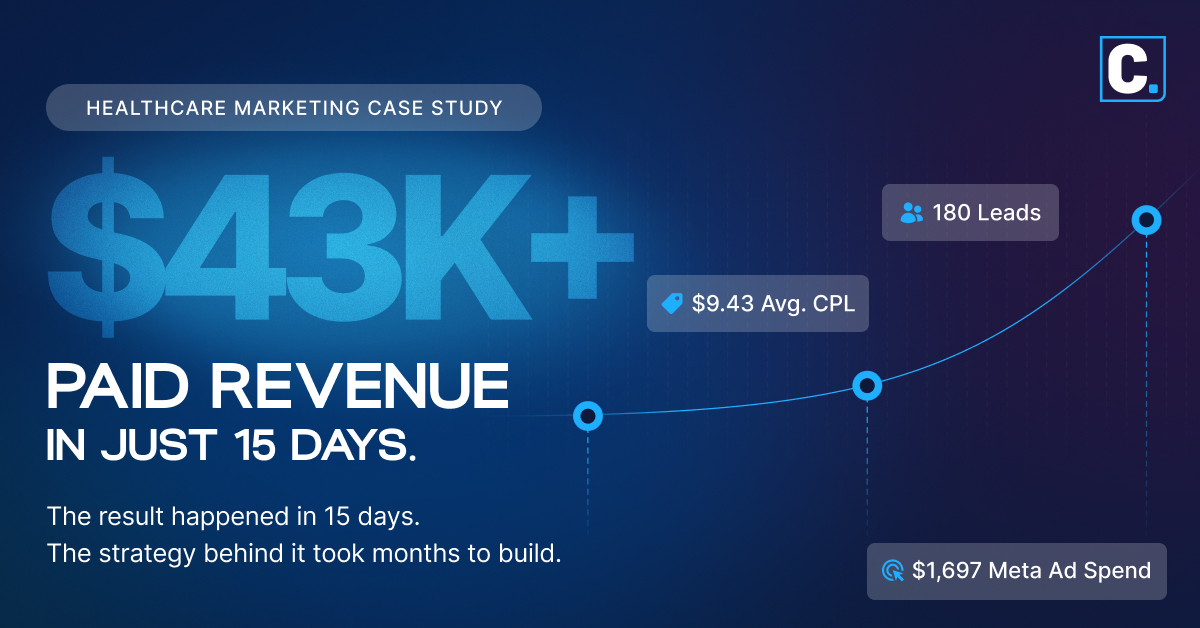
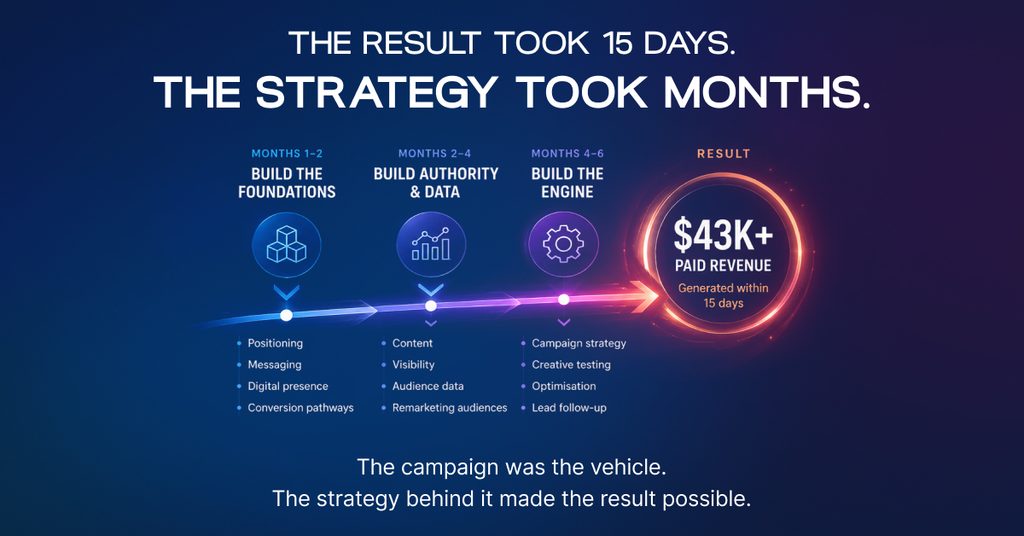
The result happened in 15 days. The strategy behind it took months to build.
$43,000+ in signed and paid revenue.
Generated within 15 days.
At first glance, it’s easy to look at a result like that and focus entirely on the campaign that generated the enquiries.
But that would miss the most important part of the story.
This wasn’t a campaign we simply switched on and watched generate $43,000.
The revenue was generated within 15 days, but the foundations behind that result had been built over approximately 4–6 months.
That’s an important distinction.
Because sustainable healthcare marketing isn’t about finding one advertisement, one platform or one tactic that suddenly transforms a business.
It’s about building the right foundations, creating visibility and authority, understanding the market, developing the right messaging and then using acquisition channels to accelerate what you’ve built.
The campaign was the vehicle.
The strategy behind it is what made the result possible.
And that distinction represents one of the biggest differences between running marketing campaigns and building a genuine growth system.
The Result: $43,000+ in Signed and Paid Revenue
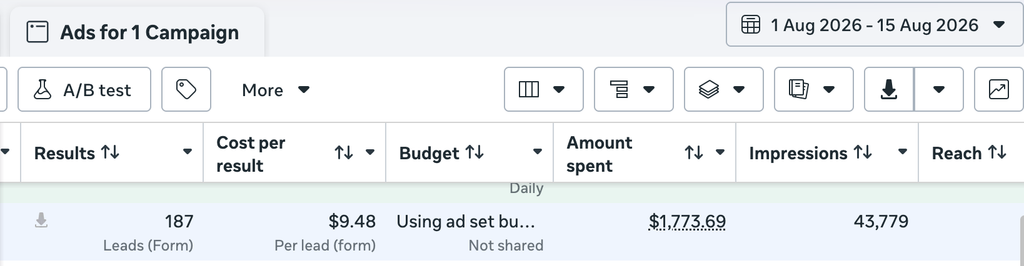
Let’s start with the outcome.
Within a 15-day period, this healthcare business generated:
$43,000+ in signed and paid revenue.
This wasn’t pipeline value.
It wasn’t estimated lifetime value.
And it wasn’t the theoretical value of enquiries generated through a campaign.
It was signed contracts and paid revenue.
The campaign also demonstrated something important about the relationship between marketing and commercial outcomes.
Generating leads is only one part of the equation.
Those leads still need to be relevant.
They need to be contacted.
They need to be qualified.
They need to trust the organisation.
And ultimately, they need to become paying clients.
That’s why we don’t believe healthcare marketing performance should be judged solely by clicks, impressions or even leads.
The real question is:
Is the marketing contributing to business growth?
Want To Build A Stronger Healthcare Growth Strategy?
Discover how the PMC Authority Growth System™ brings visibility, authority, acquisition and conversion together into one growth strategy.
EXPLORE THE AUTHORITY GROWTH SYSTEMThe Campaign Was The Vehicle, Not The Entire Strategy
One important part of this result needs to be understood.
This wasn’t a campaign we simply switched on and watched generate $43,000.
The revenue was generated within 15 days, but the foundations behind that result had been built over approximately 4–6 months.
During that period, the focus wasn’t simply on generating leads.
It was about building the broader marketing ecosystem required to support growth.
Visibility.
Brand positioning.
Messaging.
Audience understanding.
Trust.
Conversion pathways.
Campaign data.
Remarketing audiences.
And the systems required to turn marketing activity into genuine commercial opportunities.
The $43,000 result happened in 15 days.
But the foundations that made that result possible were built months earlier.
That’s an important distinction.
Because sustainable healthcare marketing rarely comes from one advertisement, one campaign or one clever creative.
It comes from building the right foundations first, then using acquisition channels such as paid advertising to accelerate what you’ve built.
Why Healthcare Marketing Needs To Start Before The Campaign
One of the most common mistakes we see businesses make is starting with the tactic.
They ask:
Should we run Google Ads?
Should we start Meta Ads?
Should we invest in SEO?
Should we post more on social media?
Should we rebuild our website?
These can all be valuable components of a healthcare digital marketing strategy.
But they’re still components.
Before deciding which channel to use, there is a more important question:
What is the strategy those channels are supporting?
Because an advertisement can generate attention.
It can generate a click.
It can even generate an enquiry.
But the advertisement doesn’t operate in isolation.
When someone discovers your organisation, they may research you.
They may visit your website.
They may look at your social media.
They may search for your organisation on Google.
They may read your reviews.
They may compare you with competitors.
They may leave and return several days or weeks later.
Every one of those interactions contributes to whether that person eventually trusts your organisation enough to enquire.
That’s why strong healthcare marketing services should never be viewed as a collection of disconnected activities.
They should work together.
What Happened During The 4–6 Months Before The Result?
The period leading into the campaign was about creating the conditions required for marketing to perform.
Rather than immediately chasing short-term lead volume, the strategy focused on strengthening the broader growth infrastructure around the business.
That meant considering questions such as:
Can the right audience find the organisation?
Is the positioning clear?
Does the messaging communicate the right value?
Does the business appear credible when someone researches it?
Are there enough touchpoints to build familiarity?
Is there an effective process for capturing demand?
What happens after an enquiry is generated?
Are we collecting enough data to improve future campaigns?
These aren’t always the most exciting parts of marketing.
But they’re often the difference between constantly chasing the next campaign and building something that becomes stronger over time.
This is also why the providers generating sustainable growth rarely depend on one source of enquiries. Instead, they build an ecosystem where people can find them, trust them, remember them and ultimately choose them.
$43K In 15 Days Was The Outcome. Not The Starting Point.
It’s easy to look at a result like this and focus entirely on the final 15 days.
But that misses the most important lesson from the case study.
The campaign didn’t create the foundations. It activated them.
Months of work had already gone into strengthening the marketing ecosystem surrounding the campaign.
That’s why the lesson isn’t:
“Run ads and generate $43,000.”
The lesson is:
Build the right foundations, develop the right strategy, then use marketing channels to accelerate growth.
The exact results will always vary.
The timeline will vary.
The investment will vary.
The channels will vary.
But the strategic process remains remarkably consistent.
And that’s precisely why PMC focuses on building growth systems rather than selling disconnected marketing services.
What Actually Creates Sustainable Healthcare Growth?
There is rarely one single answer.
SEO alone isn’t the answer.
Google Ads alone aren’t the answer.
Meta Ads alone aren’t the answer.
Social media alone isn’t the answer.
A new website alone isn’t the answer.
Each can play an important role.
The power comes from understanding how they work together.
Someone may discover your organisation through an advertisement today, see your brand again several days later, search for you on Google, visit your website, read your content and eventually make an enquiry.
Another person may discover you organically through Google and convert immediately.
Another may follow your organisation for months before making contact.
Marketing isn’t always linear.
Which is why building multiple pathways for people to discover and trust your organisation can create greater predictability over time.
That principle is already central to PMC’s existing content strategy: stronger visibility creates multiple pathways for opportunities, reduces reliance on individual referral sources and builds a stronger foundation for long-term growth.
What Could A Stronger Marketing System Mean For Your Organisation?
Book a complimentary Healthcare Growth Strategy Session and we’ll look at where your organisation is today, what’s potentially limiting growth and where the strongest opportunities may exist.
BOOK A HEALTHCARE GROWTH STRATEGY SESSIONThe Result Will Be Different For Every Healthcare Business
This is important.
No two healthcare organisations are identical.
Different services.
Different locations.
Different levels of competition.
Different budgets.
Different audiences.
Different reputations.
Different sales processes.
Different starting points.
All of these variables can influence marketing performance.
That’s why no responsible healthcare marketing agency should suggest that one organisation’s result can simply be replicated for another.
But while the outcome will vary, the strategic principle remains the same.
Build the foundations.
Create visibility.
Establish authority.
Develop trust.
Generate demand.
Capture that demand.
Convert opportunities.
Then use the data to improve the system.
That’s the strategy.
The individual channels and tactics may change depending on the business.
The underlying growth principles don’t.
Why This Matters For NDIS Providers
Competition across the NDIS market has changed significantly.
Simply being registered and providing a quality service doesn’t automatically mean participants, families, support coordinators and referral partners will discover your organisation.
That’s where NDIS provider marketing becomes important.
An effective strategy may incorporate search visibility, content, branding, paid acquisition, social media, remarketing and stronger conversion infrastructure.
But the objective shouldn’t simply be “run more ads.”
The objective should be to create a stronger overall presence so the right people can:
Find you.
Understand you.
Trust you.
And choose you.
For an NDIS marketing agency, that means looking beyond lead generation and understanding the wider ecosystem influencing participant and referral decisions.
Why This Matters For Aged Care Providers
The same principle applies to aged care marketing.
Families don’t necessarily choose a provider after seeing one advertisement.
They research.
They compare.
They ask questions.
They look for credibility.
They want reassurance that they’re making the right decision for someone they care about.
That makes trust and authority incredibly important.
A strong digital presence allows aged care organisations to build that trust before the first conversation even occurs.
Marketing then becomes more than promotion.
It becomes part of the decision-making journey.
Why This Matters For Allied Health Providers
Allied health organisations face a similar challenge.
Whether you’re operating a physiotherapy clinic, occupational therapy practice, psychology practice, speech pathology business or multidisciplinary clinic, potential clients increasingly have multiple providers to choose from.
That means an allied health marketing agency shouldn’t simply be focused on generating traffic.
The broader objective should be building a brand and digital presence capable of turning that attention into genuine demand.
Because more traffic doesn’t necessarily create more growth.
The right traffic, combined with the right strategy, can.
From Marketing Campaigns To A Marketing System
This case study represents the philosophy behind the PMC Authority Growth System™.
We don’t believe sustainable growth comes from stacking disconnected marketing services on top of one another.
SEO over here.
Google Ads over there.
Social media somewhere else.
A website built independently.
A CRM nobody really uses.
And a sales process disconnected from the marketing generating the opportunity.
That creates activity.
It doesn’t necessarily create a system.
Instead, the objective should be to connect the pieces.
Visibility → Authority → Trust → Enquiry → Conversion → Growth
Each stage supports the next.
And over time, the system becomes stronger.
That is when marketing begins to move away from constantly asking:
“Where is our next lead coming from?”
And toward building a business with multiple pathways for generating opportunities.
Marketing Should Compound
One of the biggest advantages of building the right foundations is that marketing can begin to compound.
Content builds search visibility.
Search visibility generates website traffic.
Traffic creates remarketing audiences.
Social media builds familiarity.
Video creates trust.
Case studies demonstrate credibility.
Paid campaigns capture demand.
Sales processes convert opportunities.
CRM systems retain the data.
And that data informs the next marketing decision.
Each component makes another component more valuable.
That’s fundamentally different from continually launching isolated campaigns and starting from zero every time.
And it’s why PMC’s approach focuses on long-term growth infrastructure rather than short-term marketing activity.
The Strategy Is Consistent. The Execution Isn’t.
This is perhaps the most important takeaway from the entire case study.
There is no universal healthcare marketing campaign.
What works for one organisation may not work exactly the same way for another.
An established healthcare organisation with significant brand awareness has a very different starting point from a newly launched provider.
An NDIS provider in Melbourne may face different competitive conditions from an allied health clinic in Brisbane.
An organisation investing heavily in acquisition may require a different strategy from one that first needs to improve its website, positioning or search presence.
That’s why strategy comes before tactics.
The channels should be selected based on what the business actually needs.
But regardless of the channel, the underlying objective remains:
Become easier to find.
Become easier to trust.
Become easier to choose.
That’s the foundation of sustainable growth.
Where Is Your Next Growth Opportunity?
If your organisation is investing in marketing but growth still feels inconsistent, there may be gaps between your visibility, positioning, acquisition and conversion strategy.
Book a complimentary Healthcare Growth Strategy Session and we’ll help identify where those opportunities may exist.
The Result Took 15 Days. The Strategy Took Months.
That’s the real story behind this case study.
Not simply that a healthcare business generated $43,000+ in signed and paid revenue within 15 days.
But that the result didn’t appear overnight.
There was strategy behind it.
There were foundations behind it.
There was testing behind it.
There was data behind it.
And there was an ecosystem around the campaign capable of turning marketing activity into commercial outcomes.
That’s the difference between simply running campaigns and building a growth system.
The campaign generated the opportunity.
The strategy created the conditions for that opportunity to convert.
And while every organisation’s results will be different, the principle remains the same.
Build the foundations first.
Then accelerate.